Bactericidal and Bacteriostatic Effects of Four Different Parts of 2 Plants Moringa Extracts against the Bacteria Vibrio cholerae and Salmonella typhi, and some Phytochemical Properties
Claire Stéphane Metsopkeng
Faculty of Sciences, Laboratory of Hydrobiology and Environment, University of Yaounde I, P.O. Box 812, Yaounde, Cameroon.
Geneviève Bricheux
Laboratoire « Microorganismes: Génome et Environnement » (LMGE), UMR CNRS 6023, Université Clermont Auvergne, Campus Universitaire des Cézeaux, 1 Impasse Amélie Murat CS 60026, 63178 Aubière Cedex, France.
Florence Donnadieu
Laboratoire « Microorganismes: Génome et Environnement » (LMGE), UMR CNRS 6023, Université Clermont Auvergne, Campus Universitaire des Cézeaux, 1 Impasse Amélie Murat CS 60026, 63178 Aubière Cedex, France.
Paul Alain Nana
Department of Oceanography and Limnology, Institute of Fisheries and Aquatic Sciences, University of Douala, P.O. Box 7236, Douala, Cameroon.
Isabelle Ripoche
ICCF UMR 6296, SIGMA Clermont, 20 avenue Blaise Pascal - TSA 62006, 63178 Aubière Cedex, France.
Nehemie Donfagsiteli Tchinda
Institute of Medical Research and Medicinal Plants Study, P.O. Box 13033 Yaounde, Cameroon.
Gabriel A. Agbor
Institute of Medical Research and Medicinal Plants Study, P.O. Box 13033 Yaounde, Cameroon.
Pierre Chalard
ICCF UMR 6296, SIGMA Clermont, 20 avenue Blaise Pascal - TSA 62006, 63178 Aubière Cedex, France.
Télesphore Sime-Ngando
Laboratoire « Microorganismes: Génome et Environnement » (LMGE), UMR CNRS 6023 et Laboratoire Magmas et Volcans (LMV), UMR IRD 163. Campus Universitaire des Cézeaux, TSA 60026 - CS 60026, 63178 AUBIERE Cedex, France.
Moïse Nola *
Faculty of Sciences, Laboratory of Hydrobiology and Environment, University of Yaounde I, P.O. Box 812, Yaounde, Cameroon.
*Author to whom correspondence should be addressed.
Abstract
Background and Objectives: Typhoid fever and cholera are two major health challenges in many developing countries. The use of extracts of the plants Moringa for their treatment is often done without perfect knowledge of the antimicrobial properties of each part of plant. This study aims to evaluate the bactericidal and bacteriostatic effects of extracts of M. oleifera and M. stenopetala against the bacteria S. typhi and V. cholerae which cause typhoid fever and cholera respectively.
Materials and Methods: Four different parts (leaves, seeds, stem, and roots) of each plant species were dried and then ground. The minimum inhibitory concentrations (MICs) and minimum bactericidal concentrations (MBCs) of the extracts of each part of the plants against the considered bacteria were determined by dilution method. Their phytochemical profiles were determined by chromatographic and mass spectral analyses.
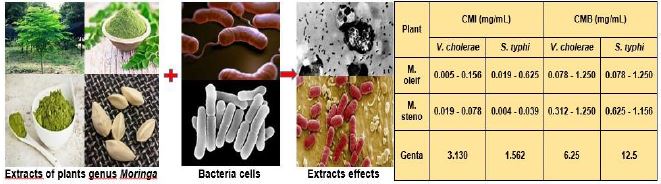
Results: It has been noted that MICs and MBCs varied from one part to another of the same Moringa species, and from one bacterium to another for the same extract. With M. oleifera, the lowest MBC (0.078 mg/mL) against S. typhi and V. cholerae came from seeds and roots extracts, respectively. With M. stenopetala, the lowest MBCs against S. typhi (0.156 mg/mL) and V. cholerae (0.312 mg/mL) were from seeds extracts. Extracts of different parts of M. oleifera have bactericidal effects against S. typhi, and bacteriostatic effects against V. cholerae. Extracts from all considered parts of M. stenopetala have bacteriostatic effects against both bacteria. Although some phytochemicals were found in both Moringa, others were specific to one species or to a given part.
Conclusion: In case of co-infection by both bacteria, M. oleifera roots extracts could be the most recommended in the treatment because of their lowest MIC and MBC. With M. stenopetala, roots and seeds extracts could be the most recommended because of their relatively lower MIC and MBC, respectively. The next studies will determine for each microorganism, the activity of each identified and purified chemical compound.
GRAPHICAL ABSTRACT
Keywords: Plants M. oleifera and M. stenopetala, plant part’s extract, antimicrobial activities, S. typhi and V. Cholerae, MICs and MBCs, phytochemicals